Innovations in ENT Surgery: Minimally Invasive Procedures and Advanced Tools
 Dr. D. Vidyasagar
Table of Contents
- A New Era in ENT Surgery
- Key Innovations Transforming ENT Care
- Minimally Invasive Surgical Techniques
- AI and Robotics in Recovery and Rehabilitation
- Why These Innovations Matter
- ENT Excellence at Star Hospitals
Ear, nose, and throat disorders are very common in any population. Everyone has taken their kids to the ENT doctor at least once. But what do you know about the new advancements in the field? The way we evaluate and treat them has undergone remarkable changes in the last decade. Minimally invasive ENT surgery, supported by sharper imaging, precision-guided instruments, and intelligent diagnostic systems, is accessible now more than ever, enabling both increased patient comfort and surgical accuracy. At Star Hospitals, these advances are part of everyday practice.
A New Era in ENT Surgery
Traditional ENT operations demanded an extensive and longer recovery. Today, the surgical scene has changed. It is guided by focused approaches with an aim to do more through smaller access points. Endoscopic procedures, refined surgical optics, and robot-assisted systems allow surgeons to treat complex conditions while preserving surrounding tissue. The result is shorter hospital stays, fewer complications, and a smoother return to routine life.
Key Innovations Transforming ENT Care
1. High-Definition Endoscopy
Modern endoscopes deliver crisp, magnified images of the nasal passages, middle ear, throat, and sinuses. This clarity helps surgeons identify subtle abnormalities that may be missed by routine examination. Narrow-band and high-definition imaging, now part of many ENT suites, supports early detection of inflammation, polyps, and small tumours.
2. Image-Guided Navigation Systems
For sinus and skull base surgery, 3D navigation tools function like a surgical “GPS.” By merging CT/MRI images with real-time instrumentation, these systems help surgeons operate precisely in narrow, delicate spaces. This reduces the chance of injury to surrounding structures and improves surgical outcomes.
3. Flexible Fibre-Optic Visualisation
Flexible scopes are especially valuable for children and for patients who cannot tolerate rigid instruments. They allow comfortable examination of the airway, vocal cords, and nasal passages. In outpatient settings, this technology supports quick diagnosis with minimal discomfort.
4. AI-Powered Diagnostic Platforms
Artificial intelligence is beginning to support ENT care in significant ways. Algorithms can highlight early tumour changes, identify patterns in sinus inflammation, and assist in hearing assessments. Machine learning tools analyse scans rapidly, helping clinicians spot abnormalities well before symptoms escalate.
Minimally Invasive Surgical Techniques
Endoscopic Sinus Surgery
Endoscopic sinus procedures allow treatment of chronic sinusitis, polyps, and anatomical blockages without external incisions. Slim instruments pass through the nostrils, guided by endoscopic cameras and navigation tools. Patients typically experience less pain, minimal bleeding, and faster recovery.
Transoral Robotic Surgery (TORS)
Robotic platforms have added a new dimension to minimally invasive throat surgery. In TORS, the surgeon uses robotic arms to access areas deep within the mouth and throat without external cuts. This is especially valuable for tumours at the base of the tongue and around the voice box. The robot’s wristed instruments and enhanced visibility allow precise removal while protecting surrounding structures.
Advances in Cochlear Implantation
Robotics and AI help in the accurate placement of cochlear implant electrodes. Improved trajectory control reduces trauma inside the cochlea. This means your residual hearing can be preserved. Patients benefit from better auditory outcomes and lower surgical risk.
AI and Robotics in Recovery and Rehabilitation
Post-operative care has also grown more intelligent. AI-driven systems can track patient healing, analyse voice rehabilitation progress, and flag early signs of complications. Remote monitoring tools allow clinicians to adjust treatment plans promptly, providing added safety during recovery.
Why These Innovations Matter
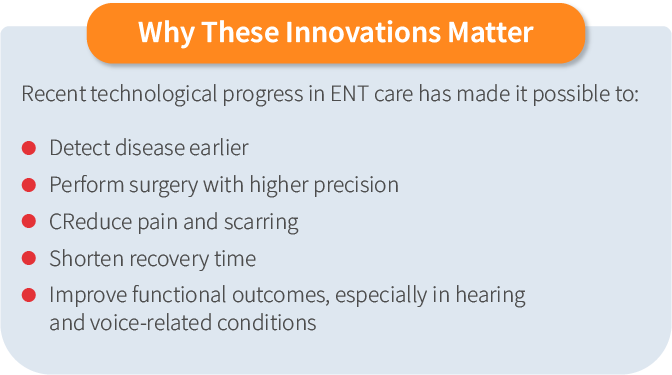
For patients, this means treatments that are gentler on the body while still delivering strong and lasting results.
ENT Excellence at Star Hospitals
At Star Hospitals, Hyderabad, ENT specialists integrate these modern tools with careful clinical judgement. Whether it is advanced endoscopy, robotic surgery, image-guided sinus procedures, or AI-assisted diagnostics, the aim remains the same: to restore comfort, clarity, and function with as little disruption as possible.
Minimally invasive care here is not defined by technology alone, but by the blend of precision, experience, and a steady commitment to patient well-being. With every procedure, the focus stays on safe treatment, clear communication, and a recovery path that brings patients back to daily life with confidence.