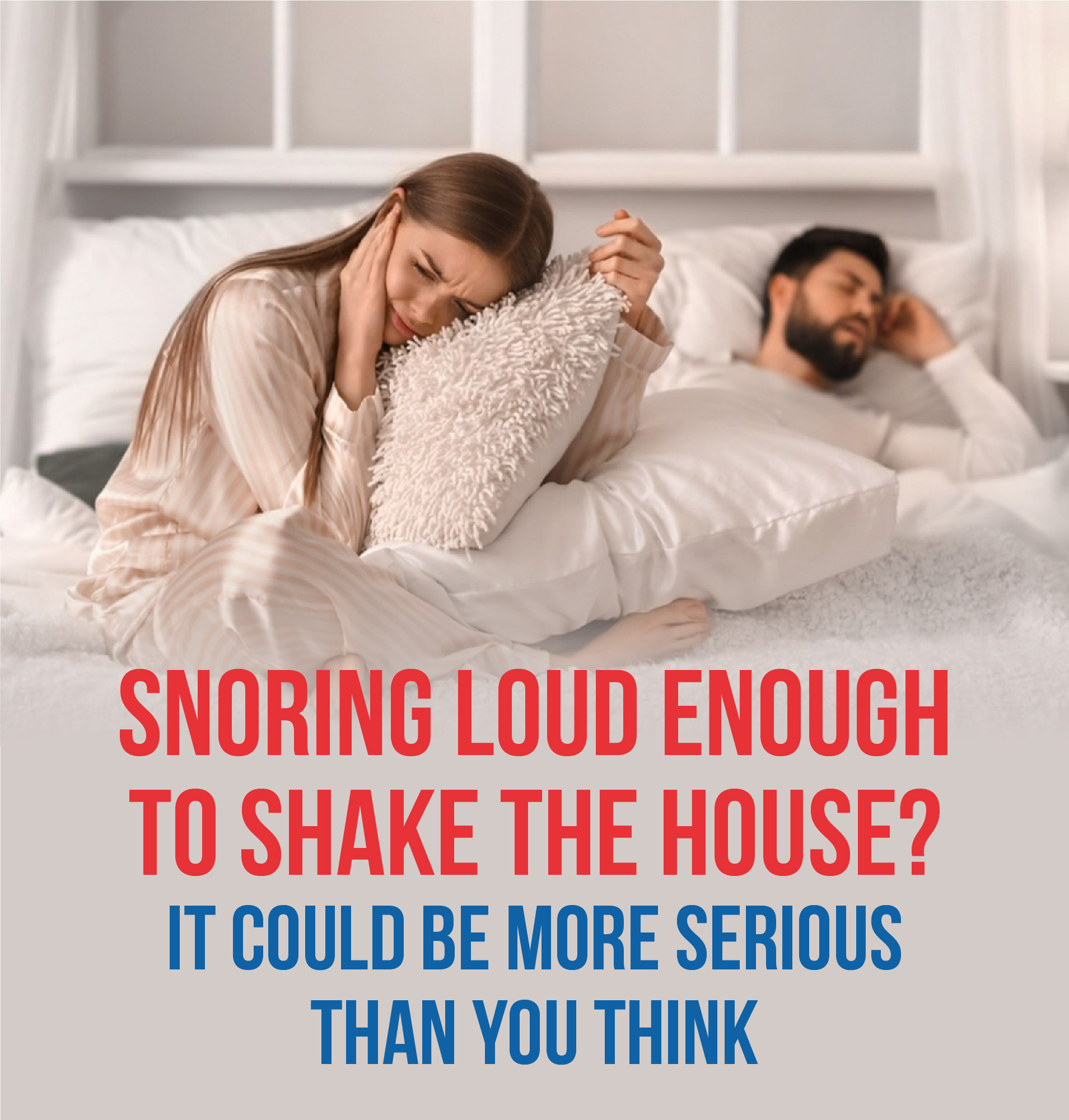
Snoring Loud Enough to Shake the House? It Could Be More Serious Than You Think
 Dr. Shareef. M.M
Table of Contents
- Why Do You Snore?
- What are Some Complications of Snoring?
- What Causes Snoring?
- Who Snores More and Why?
- How are Snoring and Other Sleep-Related Conditions Diagnosed?
- How to Control Snoring?
- Snoring in Children
Has your partner ever complained that they cannot sleep because you snore too loudly? Have you felt like you stop breathing for brief periods while sleeping? Do you feel that your snoring is affecting your relationship? Your peace of mind? Snoring is considered by many as normal and trivial. You get made fun of for snoring loudly. Your partner either gets used to it or constantly complains about it. But beyond all this, is snoring normal? Are there ways to control it?
Snoring is a common phenomenon. But persistent snoring can sometimes be a sign of a deeper issue. You may need to consult a specialist to diagnose the underlying causes and manage the symptoms before further complications develop.
Why Do You Snore?
Snoring is the harsh sound that comes out when air is pushed past the relaxed tissues of the throat, making them vibrate. To snore occasionally is normal and common, but chronic snoring can hint at serious health issues.
What are Some Complications of Snoring?
Snoring as such is not a health concern. But it is very often associated with sleep disorders like Obstructive Sleep Apnoea (OSA). This is a serious health condition that needs medical intervention. If, along with snoring, you experience any of the following symptoms, consider going to a doctor and getting evaluations done.
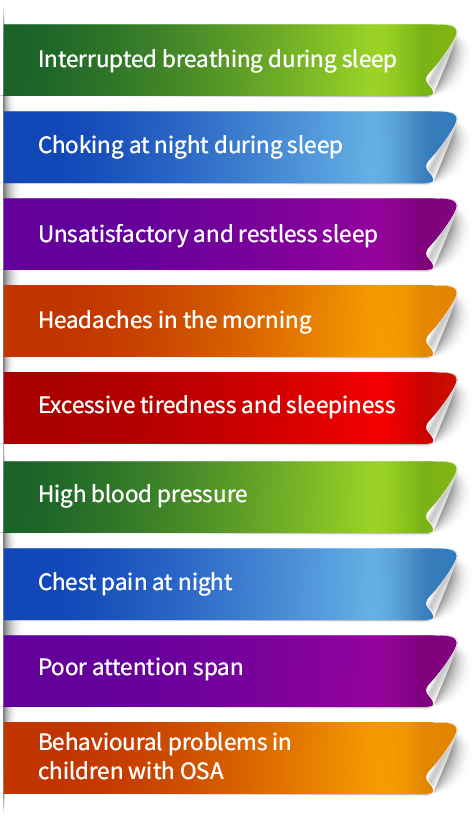
People with OSA snore loudly and have brief periods of sleep where their breathing completely stops. This wakes the person up, sometimes with a loud sound. This condition results in interrupted sleep that is tiring and disturbing to those who sleep with the patient.
What Causes Snoring?
Several factors contribute to snoring. As the body drifts to sleep, the muscles of the soft palate in the mouth relax, obstructing the airway partially. As air pushed through this narrowed pathway, the snoring sound was produced. Naturally, the narrower the airway is, the louder the snoring becomes.
-
Anatomy of the mouth: People with low and thick soft palates (upper mouth) are naturally prone to snoring more. Because of this, obese people are observed to experience snoring due to the presence of extra tissues in the throat.
-
Nasal Conditions: Those with chronic nasal congestion or structural issues in the nose are more likely to snore.
-
The position of sleeping: Snoring is more common and louder while sleeping on the back, due to the effect of gravity.
-
Drinking too much alcohol: Consuming a lot of alcohol, especially before bedtime, can cause the throat muscles to relax, making snoring more prominent.
Who Snores More and Why?
Some risk factors have been identified that cause a particular group of people to snore more than others:
-
Men snore more than women
-
Obese people are more likely to snore
-
Those who drink tend to snore more
-
Family history also plays a role. Snoring can be hereditary.
How are Snoring and Other Sleep-Related Conditions Diagnosed?
Diagnosis of snoring and other sleep-related conditions happens through various stages. The doctor first asks you, and sometimes your partner, about the signs and symptoms associated with your concern. After a physical examination, you may be asked to take some tests. This helps in assessing the severity of the condition.
-
Imaging tests like X-ray and CT scan check for problems in your nasal area and airway.
-
Sleep Study, also called Polysomnography, is done as an observation study overnight in labs. You will be connected to sensors that record the brain waves, blood oxygen level, heart and breathing rates, and eye and leg movements.
How to Control Snoring?
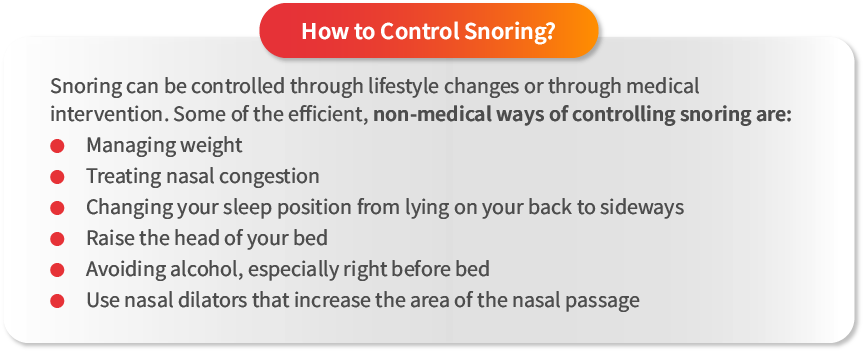
Some methods of medical intervention that help to manage snoring are:
1. Oral appliances that help properly position your tongue and jaw:
These are suggested by doctors if your snoring is caused by the wrong positioning of your mouth. The devices initially force you to keep your tongue and jaw in the right position, to which they later get habituated. The appliances are customised according to each person’s fit and requirements. Regular visits to the doctors may be required in the beginning, along with assessments of oral hygiene and health.
Concerns: Dry mouth/ excessive salivation, painful jaws and discomfort which may get better over time.
2. Continuous positive airway pressure (CPAP):
This is a procedure where you are required to wear a mask covering your nose and mouth while sleeping. The mask uses pressurised air with the help of a small bedside pump to keep the airway open. This is a common solution to snoring associated with OSA.
Concerns: Disturbance while sleeping from the feel and noise of the machine
3. Surgical solutions:
The surgery of the upper airway is a permanent solution to control snoring and other sleep-related issues, if they arise due to a structural problem in the nasal pathway. In uvulopalatopharyngoplasty (UPPP), the surgeon removes the excess tissues from the throat to open up the airway, while in maxillomandibular advancement (MMA), the upper and lower jaws are moved forward to make space for the air to pass freely without friction. In a newer technique called hypoglossal nerve stimulation, a stimulus is applied to the nerve that controls tongue movement, preventing it from blocking the airway.
Concerns: The effectiveness of the surgeries is variable and unique to each case.
Snoring in Children
Occasional snoring in children does not have to be a cause for concern. It can happen because of colds or allergies. However, frequent or loud snoring can be a signal for underlying complications such as enlarged tonsils or adenoids, nasal obstruction, or even paediatric obstructive sleep apnoea.
Children with sleep-disordered breathing may show:
-
Restless sleep or pauses in breathing.
-
Daytime sleepiness, irritability, or poor concentration.
-
Mouth breathing or delayed growth in severe cases.
Early evaluation is important because untreated sleep problems in children can affect learning, behaviour, and overall development. An ENT specialist can identify the cause and recommend treatment — ranging from medication for allergies to surgery for enlarged tonsils or adenoids.
Takeaway
Snoring can be a difficult or embarrassing issue to bring up or address. But that should not stop you from getting the medical help that you require, since it can also be a sign of hidden issues related to the nasal pathway and sleeping disorders. If you or your loved one is suffering from this condition, book an appointment with a general physician or an ENT surgeon for expert consultation.
STAR Hospitals Hyderabad offers one of the best services in treating sleep-related issues, including OSA, through various patient-friendly methods. Experience the quality of world-class health care and expertise fused with empathy at STAR. Book an appointment today, say yes to health, and happy living.