How a Muscle-Sparing Knee Replacement Helped a 59-Year-Old Regain Independence Faster
 Dr. Shashi Kanth G
Table of Contents
- Understanding the Challenge: Knee Degeneration and Replacement
- Standard Knee Replacement Procedure
- A Different Surgical Approach
- How the Subvastus approach changes the recovery process
- Recovery: A Shift in Timeline
- The Human Side of Recovery
- A Surgeon’s Perspective
When 59-year-old Ms Venkata Lakshmi was advised to undergo a total knee replacement (TKR), she faced a concern many patients share: what comes after the surgery. It was not just the operation that worried her, but the long, often demanding recovery that typically follows. Stories of extended bed rest, weeks of physiotherapy, and dependence on family members had shaped her expectations.
What she experienced instead was a recovery that moved at a very different pace.
At STAR Hospitals Nanakramguda, a refined surgical technique offered her an alternative path, one that focused not only on correcting the joint but also on preserving the body’s natural strength.
Understanding the Challenge: Knee Degeneration and Replacement
Total Knee Replacement is commonly recommended for patients with severe knee damage, often due to osteoarthritis. This condition gradually wears away the cartilage, leading to pain, stiffness, and difficulty in movement.
Standard Knee Replacement Procedure:
-
Damaged portions of the knee joint are removed and replaced with artificial components.
-
While the surgery itself is highly effective in relieving pain, it involves cutting through the quadriceps muscle (the large muscle at the front of the thigh) to access the joint.
-
Since the quadriceps play a crucial role in walking, standing, and climbing stairs, when it is cut and later repaired, it requires time and structured physiotherapy to regain strength. As a result, recovery can extend over several weeks, sometimes longer, depending on the patient’s age and overall health.
A Different Surgical Approach:
-
For Ms Venkata Lakshmi, the procedure was performed using what is known as the subvastus approach—a muscle-sparing technique in knee replacement surgery.
-
This method allows the surgeon to reach the knee joint without cutting through the quadriceps muscle. Instead, the muscle is gently moved aside. By preserving the integrity of this key muscle group, the body retains much of its natural strength immediately after surgery.
-
The procedure was carried out by Dr. Shashi Kanth G, Senior Consultant Orthopaedic Surgeon, who has extensive experience in advanced joint replacement techniques.
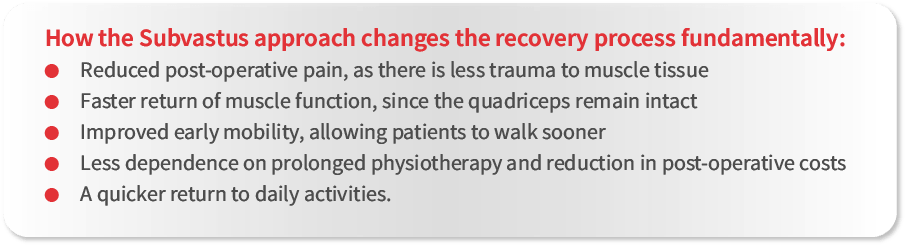
How the Subvastus approach changes the recovery process fundamentally:
Recovery: A Shift in Timeline
In conventional Total Knee Replacement Surgery cases, patients are typically advised to undergo structured physiotherapy for about 4 to 6 weeks. This is essential for rebuilding muscle strength and restoring joint movement.
Ms Venkata Lakshmi’s experience differed markedly. Because her quadriceps muscle was preserved during surgery, her recovery progressed rapidly. Within approximately 10 days, she was able to regain a level of independence that would usually take several weeks.
This does not mean that movement or guidance is unnecessary after surgery. Early mobilization, basic exercises, and careful monitoring remain important. However, the intensity and duration of rehabilitation are often reduced.
The Human Side of Recovery
Reflecting on her experience, Ms. Venkata Lakshmi described a sense of relief that went beyond physical healing:
“Only someone going through this can truly understand the difference. The surgery was quick, I felt relief early, and now I can manage on my own.”
Her family, who had initially been uncertain about choosing a relatively less familiar technique, shared a similar sentiment. Like many others, they had prepared themselves for a long recovery period. Watching her regain independence much sooner than expected brought both reassurance and gratitude.
A Surgeon’s Perspective
For the operating surgeon, the success of a procedure is closely tied to the patient’s quality of life after surgery.
Dr. Shashi Kanth G notes that advancements in surgical techniques are not only about improving precision but also about reducing the physical strain on the patient.
“When a patient can return to their routine sooner, with less discomfort and more confidence, that is where the real value lies,” he explains. “The goal is not just to perform a successful surgery, but to make recovery smoother and more practical for everyday life.”
Looking Ahead
The subvastus approach represents a broader shift in orthopaedic care towards techniques- less invasive, more patient-friendly, and focused on faster functional recovery.
It is important to note that not every patient may be suitable for this approach. Factors such as body structure, severity of joint damage, and overall health can influence the choice of surgical method. A thorough evaluation by an experienced orthopaedic specialist remains essential.
Conclusion
Ms. Venkata Lakshmi’s journey reflects how thoughtful changes in surgical practice can reshape the patient experience. By preserving the body’s natural structures wherever possible, recovery becomes less about enduring limitations and more about regaining control.