Table of Contents
- Modern Cardiac Surgery And Its Technology
- The Role of AI and ML in Cardiac Surgery
- Recent Innovations in Open Heart Surgery
- Minimally invasive cardiac surgery
- Beating Heart Surgery
- Valve surgery
- Heart Transplant and OCS
- Ventricular Assist Devices
- Stem cell therapy
- The Integration of Telemedicine and Remote Monitoring
- Future of Technology in Cardiac Surgery and Treatment
- Take Charge of Your Heart Health- Choose Star Hospitals
“The only lasting beauty is the beauty of the heart,” says Rumi. The heart is the core of our being—a life-sustaining organ that powers our body. Without a healthy heart, life itself is at risk. Cardiovascular health has always been a prime topic of research for centuries, and India, as a nation, has nurtured this research with advanced organ transplant procedures.
In the past few years, cardiac surgery has transformed drastically. This is largely due to the improvement in technology. The old, highly invasive procedures with long recovery times have changed to Minimally Invasive Techniques (MIT), AI-powered diagnostics, and robotic surgery. Today's patients can expect reduced complications as well as shorter overall hospital stays, which means they can go home and start their recovery sooner. Heart care has changed the entire domain of medicine with greater precision, alongside faster recovery for the patients post-operation.
Modern Cardiac Surgery And Its Technology
Technological innovations have significantly improved patient outcomes in cardiac surgery, making procedures safer, more precise, and minimally invasive. Some of the key technology advancements are:
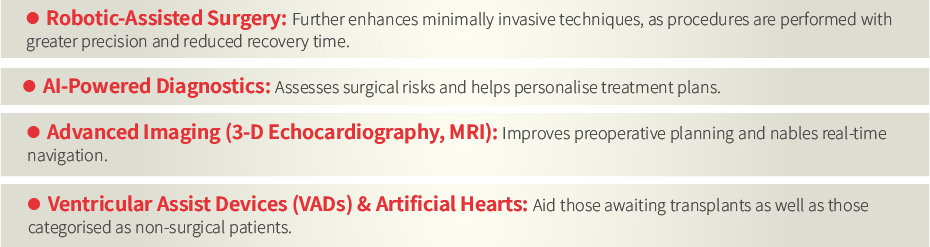
These advances prove that cardiac treatments are not only efficient but also engineered for optimal recovery and sustainable long-term results. Cardiac care is being fundamentally altered by the integration of artificial intelligence, robotics, and data analytics, which enables effective treatment of even the most intricate heart diseases with unmatched accuracy.
The Role of AI and ML in Cardiac Surgery
Artificial Intelligence (AI) and Machine Learning (ML) are some of the modern technologies that have focused and transformed the scope of medical studies and research. There have been advancements in the quality of surgery done in every type of surgical procedure, including robotic cardiac surgery.
1. Revolutionising Healthcare: AI-powered tools are improving diagnostics, providing personalised treatment plans, and accelerating drug discovery. Machine Learning algorithms can analyse medical imaging to detect anomalies, often with greater accuracy than human practitioners
2. Robotics: Advances in medical technology will be spearheaded by machine learning, empowering existing robots to perform new precision tasks.
3. Epidemiology: Infectious disease outbreaks can be predicted and monitored with AI.
Recent Innovations in Open Heart Surgery
1. Minimally invasive cardiac surgery :
In this innovative procedure, mini-incisions are made on the left or right of the thoracic cavity to gain access to the heart. This addresses the worry of many about having the chest cut open, as in the case of conventional cardiac surgery. The incision is smaller. This ensures that the risks of wound infection following sternal trauma are avoided. Other benefits of minimally invasive cardiac surgery include smaller incisions, reduced postoperative complications, shorter hospital stays, and less physical restriction.
2. Beating Heart Surgery:
Coronary artery bypass grafting (CABG) is one of the most commonly performed heart surgeries, which provides both symptom relief and long-term benefits. The procedure is done while the heart is still beating. Beating heart CABG is especially preferred for patients with kidney problems, hardened arteries (aortic calcification), or several other health conditions.
3. Valve surgery:
In India, the most common reasons for valve surgery are rheumatic heart disease and age-related degenerative (calcific) valve disease. The introduction of bi-leaflet mechanical valves in the 1980s was a major advancement that revolutionised artificial heart valve technology.
Transcatheter aortic valve implantation:
This is a big breakthrough in stenosed aortic valve management, used on patients where conventional valve replacement is not possible or is associated with high risk. The procedure is performed through a transfemoral approach.
4. Heart Transplant and OCS:
Orthotopic heart transplantation is a standardised procedure with long-term results where the diseased heart is replaced with a healthy heart from a donor. Recent advancements in heart transplantation led to the development of the ‘organ care system’. This innovative technology keeps the donor heart warm, perfused, and beating during transport, closely mimicking natural conditions. The OCS allows for better assessment of organ function, extends the preservation time, and potentially improves transplant outcomes, especially when transporting hearts over long distances.
5. Ventricular Assist Devices:
A ventricular assist device (VAD) — also known as a mechanical circulatory support device — is an implantable mechanical pump that helps pump blood from the ventricles to the rest of the body. VADs can be used for both short-term use (like IMPELLA and CENTRIMAG) and long-term use (like HEART MATE II and III) to treat acute refractory heart failure.
6. Stem cell therapy:
This is highly beneficial for patients with Myocardial Infarction and Refractory Heart Failure. Patches of human heart muscle cells derived from the stem cells are transplanted onto the surface of a failing heart. This approach is feasible and safe. Its functional benefits are still being investigated.
7, The Integration of Telemedicine and Remote Monitoring
Telemedicine bridges gaps in accessibility and improves patient outcomes, enabling remote diagnostics and consultations.
Future of Technology in Cardiac Surgery and Treatment
Technology's advantage in treating diseases of the heart is set to change cardiac surgeries and how heart diseases are diagnosed, their treatment, and their management.
1. Artificial Intelligence (AI) and Machine Learning:
AI helps predict the outcomes of the patient, detects patients at high risk, and advises a treatment plan suited to them.
2. Robotics Surgery:
Surgeries performed with the assistance of robots tend to have smaller cuts and scars and allow for quicker recovery periods.
3. Advanced Imaging and Navigation:
- 3D Imaging: 3D imaging of the heart provides surgeons with an accurate representation of the organ, which increases their precision.
- Augmented Reality (AR): AR adds real-time visuals and data during surgery, helping surgeons see and understand the area better.
- Virtual Reality (VR): VR can be used for pre-surgical planning and training, simulating complex cardiac procedures.
4. Wearable and Implantable Devices:
- Smart Wearables: Devices such as smartwatches and patches monitor heart rhythms, blood pressure, and other vital signs.
- Next-Gen Pacemakers: Lesser implantable pacemakers that operate wirelessly, more peacefully, with a prolonged life battery and better features.
- Implantable Sensors: Devices used to continuously monitor cardiac health are proactive, providing instant information on a patient's condition.
5. Gene and Cell Therapy:
CRISPR and stem cell therapy may revolutionise cardiac disease treatment.
6. Nanotechnology :
Delivers medication directly to damaged heart tissues, minimising side effects. It also helps in the early detection of biomarkers for heart disease.
Take Charge of Your Heart Health- Choose Star Hospitals
The integration of technology into cardiac surgery will continue to push the boundaries of making treatments more effective, accessible, and personalised. Star Hospitals Hyderabad is one of the best cardiac surgery hospitals in Hyderabad, which has proven its expertise in redo surgeries, complex heart procedures, and high-risk cardiac interventions. It has transformed cardiac care in India, pioneering high-risk interventions like Minimally Invasive Surgery, TAVI, and TAVR, with an impressive success rate of 99.8%.
“At STAR Hospitals, our legacy in cardiac care runs deep. When we first began, our focus was on Cardiology and Cardiac Surgery, supported by a few other specialities. Over time, as patients returned seeking additional medical services, STAR’s leadership expanded expertise to include Nephrology, Neurology, Orthopaedics, and more, shaped by the very trust and needs of our patients.”
Your heart is your lifeline—do not take it for granted. Take Charge of Your Heart Health. Start prioritising your heart today for a healthier tomorrow. Stay active, eat a balanced diet, manage stress, and get regular check-ups. Making small, consistent changes now can prevent bigger problems in the future. In case of any heart health concerns, only approach the best, book an appointment with Star Hospitals, and rest assured, your health is in expert hands.