Silent Growths Inside the Body: Large Rectal Polyps Can Turn Cancerous If Ignored
 Dr. Y Rami Reddy
Table of Contents
- Clinical Evaluation and Diagnosis
- Advanced Endoscopic Treatment
- Outcome and Recovery
- Why Colonoscopy Matters
- Treating Doctors
Colorectal polyps are abnormal tissue growths that develop on the inner lining of the large intestine or rectum. While many polyps remain small and harmless, large rectal polyps can grow silently for years without causing noticeable symptoms. If left undetected, some of these polyps carry the potential to progress into colorectal cancer.
A 56-year-old male presented to the STAR Gastroenterology OPD with severe rectal bleeding, which had resulted in significant anemia. Due to ongoing blood loss, he had already required blood transfusions at another hospital. Given the severity and persistence of symptoms, further evaluation was undertaken to identify the cause.
Clinical Evaluation and Diagnosis
Colonoscopy revealed a large sessile rectal polyp measuring approximately 3 cm. Sessile polyps are of particular clinical concern due to their broad base, higher bleeding risk, and increased potential for malignant transformation.
To accurately assess the depth of involvement and determine suitability for endoscopic treatment, a rectal endoscopic ultrasound (EUS) was performed. The EUS demonstrated that the lesion originated from the second and third layers of the rectal wall, confirming that it could be safely managed using advanced endoscopic techniques.
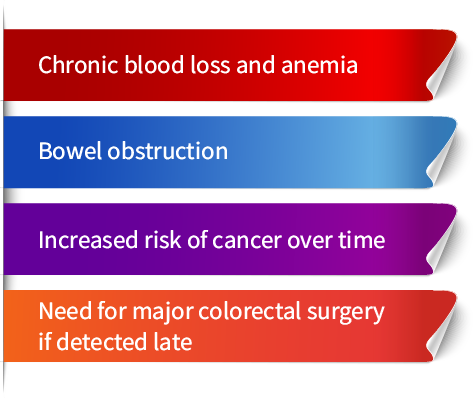
Large rectal polyps, especially those associated with bleeding, can lead to:
Advanced Endoscopic Treatment
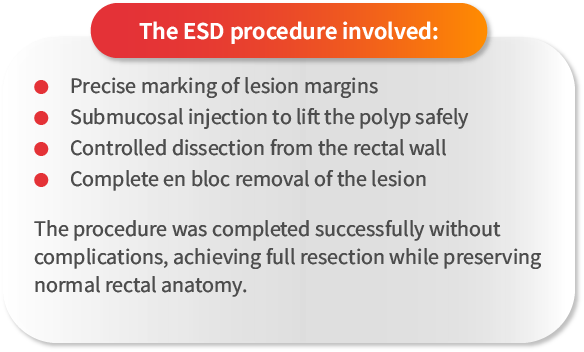
Based on these findings, the patient underwent Endoscopic Submucosal Dissection (ESD)—a specialised endoscopic procedure that enables complete removal of large polyps in one piece, avoiding the need for open or laparoscopic surgery.
Outcome and Recovery
Following the procedure, rectal bleeding resolved completely, and hemoglobin levels stabilised without the need for further transfusions. Histopathological examination confirmed tubular adenoma with areas of high-grade dysplasia, validating the importance of early removal. Prompt endoscopic intervention helped the patient avoid major colorectal surgery and ensured faster recovery.
Why Colonoscopy Matters
Most colorectal polyps are asymptomatic and do not cause pain in the early stages. Symptoms such as rectal bleeding, anemia, unexplained weight loss, or changes in bowel habits should never be ignored. Medical guidelines recommend screening colonoscopy from 45–50 years of age, or earlier in individuals with symptoms or a family history of colorectal cancer.
Early detection through colonoscopy allows removal of polyps before cancer develops.
Treating Doctors
Dr. Y. Ramireddy, MD, DM
HOD – Interventional Gastroenterology
And Team- STAR Hospitals, Nanakramguda
With contributions from Dr. Bharath Kumar Palle, Surgical Oncology
STAR Hospital.